Georgia Gun Laws for Travelers: Can I Carry a Gun in My Car?
Speak with a trusted Superior Court Lawyer in Georgia.
Quick Facts
- Law: O.C.G.A. § 16-11-126 (carrying in vehicles)
- Without a Permit: Yes, if you’re a lawful weapons carrier and the gun is stored in glove box, console, closed container, or locked rack
- With a Permit: You can carry openly or concealed in your car, even loaded
- Restrictions: Not allowed in certain locations (schools, courthouses, government buildings, places of worship without permission)
- Age: 18+ for handguns; no age limit for rifles/shotguns
- Prohibited Persons: Felons, those with domestic violence convictions, active restraining orders, unlawful drug users
- Traveling: Federal law requires unloaded + locked storage when crossing state lines without reciprocity
Georgia car gun laws regulate the use, ownership, and carrying of firearms and ammunition in the state of Georgia in the United States.
Author: Philip Kim, Founder, Philip Kim Law, P.C.
Defense lawyer Philip Kim has committed his career to standing up for the accused, and protecting the rights and reputations of his valued clients. If you face criminal charges in Georgia, we can provide you with the skilled, effective defense representation you need.
Published on July 07, 2022. Updated on: September 02, 2025.

Is It Illegal To Have a Gun in Your Car?
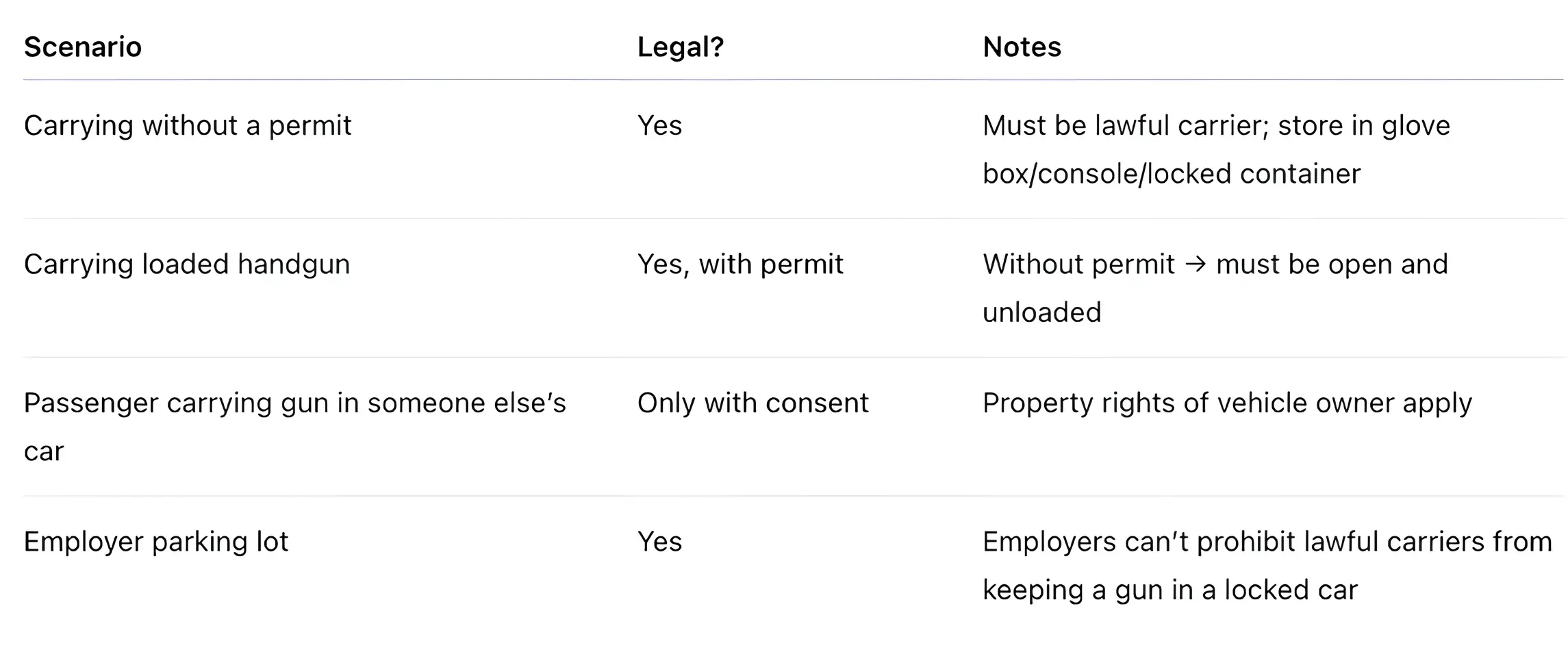
A gun in your car is illegal without a valid weapons carry license. Individuals with Georgia weapons carry licenses may possess or carry handguns or long guns in private vehicles.
If a weapon or long gun is discovered on private property, including a car, the owner, renter, licensee, contractor, or anyone in legal control of the property can kick the individual out.
Therefore, if you are a passenger in another person’s motor vehicle, you need their explicit consent to carry a firearm in their car. You need to notify the owner and get their permission before taking a firearm, even if you do not intend to use it.
However, the privileges above do not apply to individuals prohibited by law from possessing or carrying firearms.

Understanding Georgia Gun Laws for Travelers
Georgia law allows individuals who are not prohibited by law from possessing firearms to have or carry a firearm in their personal motor vehicle. Your car is considered an extension of your home.
Licensed weapon carriers can possess a firearm or weapon in a motor vehicle parked in a parking area of firearm-free areas—for example, government buildings, courthouses, places of worship, and schools. You can have your firearm so long as it is locked in the glove compartment of the vehicle, in a closed container, or locked firearms rack on the car.
The legislature has introduced a bill to allow people to carry firearms anywhere in the car, but it is not yet a law.
Georgia Gun Laws About Traveling
Georgia law prohibits anyone without a weapons carry license from boarding or attempting to board an aircraft, bus, or rail vehicle with firearms.
Firearm and ammunition owners are protected by federal law when traveling between states where firearms can be lawfully carried and where they can only be carried while unloaded and locked in the trunk.
If you plan on traveling to another state, make sure you know the laws of the states you travel to to get protection.
Locations With “No Firearms” Signs and Private Property Rights
Even under Georgia’s broad gun-carrying laws, private property owners retain the right to restrict firearms on their premises. Businesses that post “No Firearms” or similar signage may lawfully prohibit weapons inside their buildings. This includes restaurants, retail stores, and other private spaces that are not state-owned.
However, Georgia law—specifically O.C.G.A. § 16-11-135—protects the rights of lawful weapons carriers to keep firearms locked in their private vehicles, even when parked on an employer’s property. An employer generally cannot search a locked vehicle or discipline an employee for having a lawfully possessed gun inside it, as long as it remains secured.
Certain areas remain fully off-limits regardless of signage, such as schools, courthouses, government buildings, jails, and places of worship without permission.
Understanding these distinctions helps travelers and residents avoid unintentional violations while parking or visiting private locations.
When unsure about property restrictions or posted signage, seek clarification before carrying or leaving a firearm in your vehicle.
Who Is Prohibited From Carrying a Firearm in Georgia
Although Georgia’s permitless carry law expanded access for many citizens, not everyone qualifies as a lawful weapons carrier. State and federal laws list several disqualification factors beyond felony convictions that can make firearm possession illegal.
You may be prohibited from carrying a gun in Georgia if you:
- Are subject to an active protective or restraining order involving domestic violence.
- Have been convicted of certain misdemeanor domestic-violence offenses.
- Are you an unlawful user of controlled substances or addicted to drugs?
- Have been adjudicated mentally incompetent or committed to a mental institution.
- Are under 21 years of age (unless active-duty military, per O.C.G.A. § 16-11-129).
- Are otherwise restricted under 18 U.S.C. § 922(g) of federal law.
Violating these provisions can result in serious criminal penalties, including felony charges and loss of firearm rights. Because determining eligibility can be complex, consulting a qualified criminal defense attorney in Georgia can help clarify your legal status before carrying a firearm in your vehicle.

Criminal Charges and Consequences for Illegal Firearm Possession
Individuals found with firearms in violation of Georgia law may face serious criminal charges. These charges depend on whether the person is a prohibited possessor, where the weapon was located, and whether the individual had the owner’s consent to keep the firearm in the vehicle.
Common consequences include:
- Misdemeanor charges – For less severe violations, such as failure to store a firearm properly or carrying in certain restricted zones.
- Felony charges – For unlawful firearm possession by felons, transporting a firearm during the commission of another crime, or possession in high-security areas such as jails or courthouses.
- Collateral consequences – A conviction may prevent employment in certain fields, affect immigration status, or restrict civil rights.
In some cases, individuals who have served their sentence may seek the restoration of gun rights. However, this process is complex and typically requires legal assistance to petition the court and demonstrate rehabilitation.
Misdemeanor vs. Felony Classifications in Georgia Gun Cases
When facing criminal charges involving firearms, it is important to understand how the law differentiates between a ranking misdemeanor and a felony.
- Misdemeanor firearm offenses:
- Carrying a firearm into a restricted area without criminal intent.
- Failure to secure a firearm properly in a vehicle.
- Often punishable by up to 12 months in jail and fines.
- Felony firearm offenses:
- Possession of a firearm by a convicted felon.
- Carrying a firearm while committing another crime (such as drug trafficking).
- May result in multiple years in prison, large fines, and permanent loss of firearm rights.
Understanding whether a violation is treated as a ranking misdemeanor or escalates to a felony can make the difference between probation and years of incarceration. Felony-level penalties for violations are much more severe and may permanently impact your civil liberties.

Penalties for Violating Gun Laws in Georgia
Violating Georgia gun laws carries serious legal consequences that vary depending on the offense. While some violations may be treated as misdemeanors, others are classified as felonies with harsh sentences. Understanding these penalties is essential for anyone carrying a firearm in a vehicle or other public setting.
Misdemeanor Penalties
Certain firearm violations are treated as misdemeanors. Examples include bringing a gun into a prohibited location without criminal intent or failing to store it properly in a vehicle.
- Punishment: Up to 12 months in jail and/or fines of up to $1,000 (O.C.G.A. § 17-10-3).
- Some misdemeanors may be elevated to misdemeanors of a high and aggravated nature, with fines up to $5,000 and longer probation terms.
Felony Penalties
Many gun-related offenses are classified as felonies, especially when they involve prohibited individuals or firearms used during other crimes.
- Possession of a firearm by a convicted felon: Punishable by 1–10 years in prison (O.C.G.A. § 16-11-131).
- Possession or use of a firearm during the commission of a felony: An additional 5 years in prison, served consecutively to the underlying offense (O.C.G.A. § 16-11-106).
- Carrying a firearm onto school property or into a courthouse: Felony punishable by 2–10 years in prison and fines up to $10,000.
Repeat Offenders and Aggravating Circumstances
Georgia law imposes harsher penalties for violations when the offender has prior convictions or when the firearm is used in connection with violent or drug-related crimes. Repeat felons often face the maximum sentence allowed, and parole eligibility may be restricted.
Collateral Consequences
Beyond fines and incarceration, a conviction for a firearm violation can result in:
- Loss of the right to own or carry firearms (sometimes permanently).
- Difficulty obtaining employment in fields requiring security clearance or licensing.
- Immigration consequences, including possible deportation for non-citizens.
- Challenges with restoration of gun rights, which requires a separate legal process after the sentence is completed.

Georgia Statutes and Legal Texts on Carrying Weapons in a Vehicle
Georgia law is explicit about the regulations concerning carrying a weapon in a vehicle. According to O.C.G.A. § 16-11-126, any lawful weapons carrier may transport a firearm in their vehicle without a weapons carry license. This provision includes individuals who are legally permitted to possess firearms but do not require a license for transport.
However, O.C.G.A. § 16-11-127(a) specifies that carrying a weapon or long gun in unauthorized locations is prohibited. This statute outlines the restrictions on carrying firearms in certain public places, such as government buildings, courthouses, jails, and places of worship, unless explicitly allowed by the governing body.
Another critical statute is O.C.G.A. § 16-11-129, which details the requirements for obtaining a Georgia Weapons Carry License (GWCL). This law states that individuals who wish to carry a handgun in public, including in their vehicle, must possess a valid GWCL unless they fall under specific exemptions such as being a law enforcement officer or a member of the military.
Moreover, O.C.G.A. § 16-11-130 provides exemptions for certain individuals and activities. For example, peace officers, members of the armed forces, and hunters during legal hunting activities may carry firearms without adhering to the restrictions imposed on the general public.
It’s also essential to consider federal laws that interact with state regulations. The Gun Control Act of 1968, found in 18 U.S.C. § 922, regulates the interstate transport of firearms. Under this federal statute, a firearm must be unloaded and locked in a container separate from the ammunition if the individual does not have a permit recognized by the destination state.
For comprehensive understanding and compliance, consulting these statutes directly and seeking legal advice is advisable. These laws ensure that while the right to bear arms is upheld, it is balanced with public safety concerns.

Contact a Criminal Defense Lawyer in Georgia
You may face serious criminal charges if you are not a lawful weapons carrier and have been charged with carrying a gun in your car. However, if you are unsure whether or not you were acting within the law, it is essential to consult an experienced criminal defense lawyer.
At Philip Kim Law, P.C., we understand Georgia’s complex firearm laws and can help protect your rights. Our skilled attorneys will provide sound legal advice and defend your rights in court. If you have questions about seeking the restoration of gun rights after a conviction, our team can also guide you through the process.
Do not hesitate to contact us if you have been charged with a gun crime. We are dedicated to safeguarding our clients’ rights and ensuring they receive fair legal treatment. Call or visit our website today for more information.

Frequently Asked Questions About Georgia Gun Laws for Travelers
1. Can I carry a gun in my car in Georgia without a permit?
Yes. Under Georgia law, lawful weapons carriers may keep a firearm in their vehicle without a weapons carry license. The gun must be stored in the glove box, console, closed container, or locked rack if you don’t have a license.
2. Can I carry a loaded gun in my car?
Yes, but only if you have a valid Georgia Weapons Carry License. Without a license, the firearm must be unloaded unless it is openly carried and meets the legal requirements for lawful transport.
3. Do I need the owner’s permission to bring a gun into someone else’s car?
Yes. Georgia law recognizes the property rights of the vehicle owner. If you’re a passenger, you must get the driver’s or owner’s consent before bringing a firearm into their vehicle.
4. Can my employer stop me from keeping a gun in my car?
No. Georgia law prevents employers from prohibiting lawful weapons carriers from keeping a firearm locked inside their private vehicle in workplace parking areas.
5. Are there places I still can’t have a gun in my car?
Yes. Even in your car, firearms are restricted in certain locations, such as courthouses, government buildings, schools, jails, and places of worship without permission from the governing body.
6. What happens if I’m caught with a gun in my car illegally?
Carrying a firearm in violation of Georgia law can lead to misdemeanor or felony charges, depending on the situation. Penalties may include fines, jail time, and loss of firearm rights.
7. Do Georgia’s new permitless carry laws apply to vehicles?
Yes. As of 2022, Georgia law allows “lawful weapons carriers” to carry handguns openly or concealed in public places, including vehicles, without a license. However, this does not apply to individuals prohibited from possessing firearms.
8. What are the age limits for carrying guns in cars?
- Handguns: You must be at least 18 years old to legally possess and carry.
- Rifles and shotguns: No minimum age under Georgia law, though federal restrictions may still apply.
9. Can I travel out of state with a gun in my car?
Yes, but rules vary by state. Federal law allows transport if the firearm is unloaded, stored in a locked container, and separated from ammunition when traveling between two states where possession is legal. Always check the destination state’s laws.
10. Who is prohibited from carrying a gun in Georgia at all?
Prohibited persons include convicted felons, individuals with domestic violence convictions, those subject to certain protective orders, unlawful drug users, and individuals deemed mentally incompetent by the courts.

Request a Free Legal Consultation
Lawrenceville, GA 30046